
_Page_1_Web.png)
Drawings
To view the drawings, you can either click on the image, or the link below.


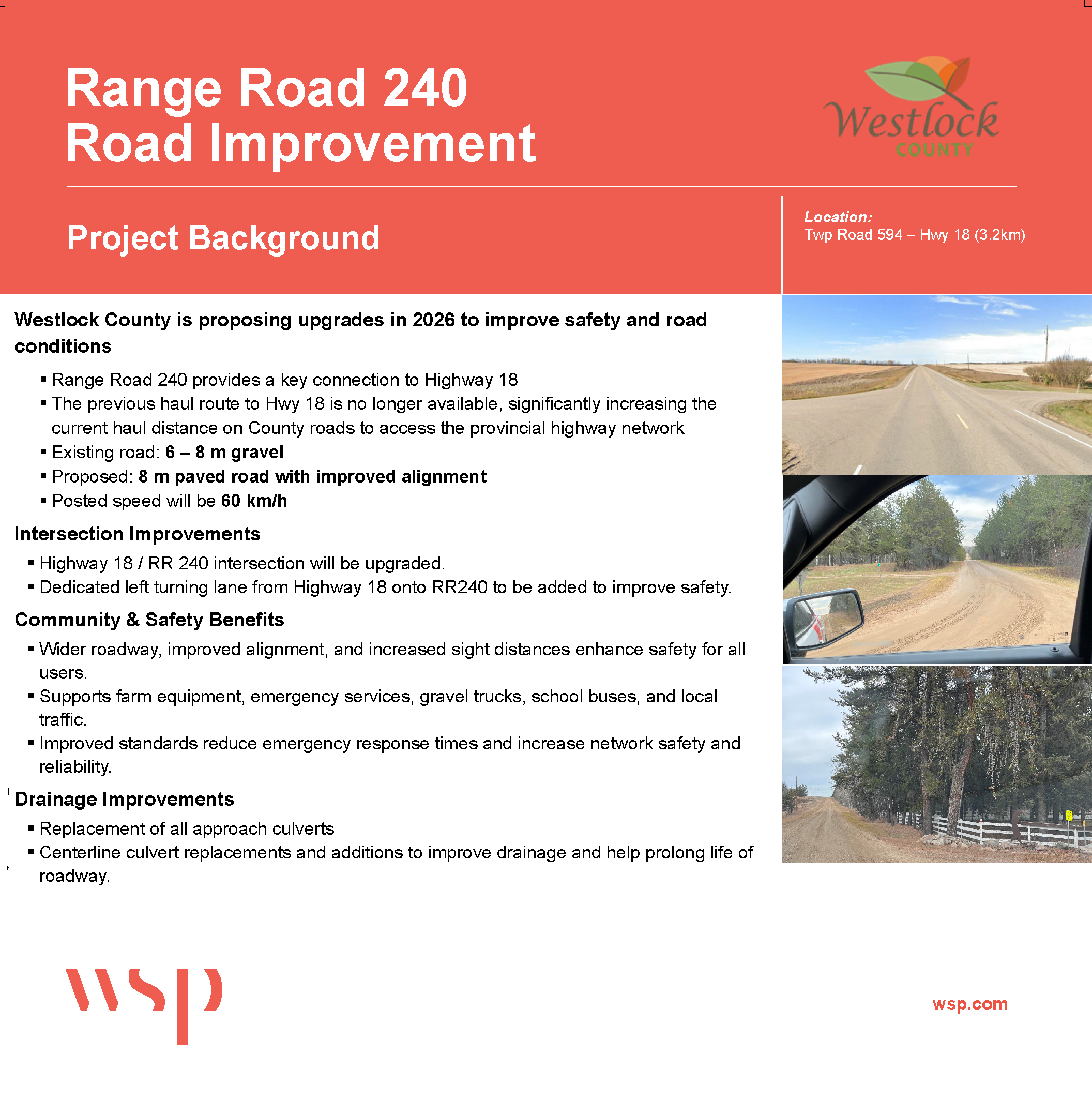
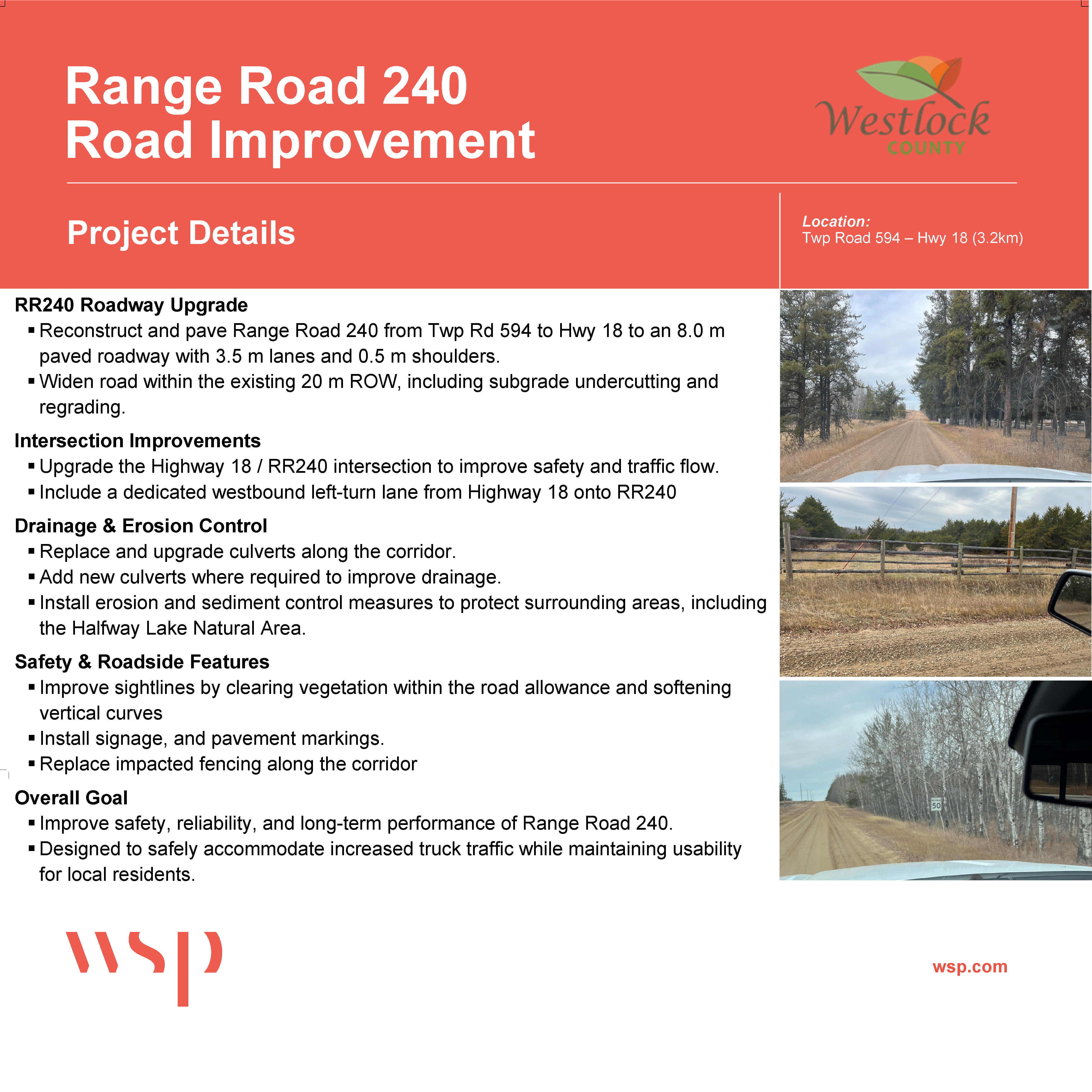
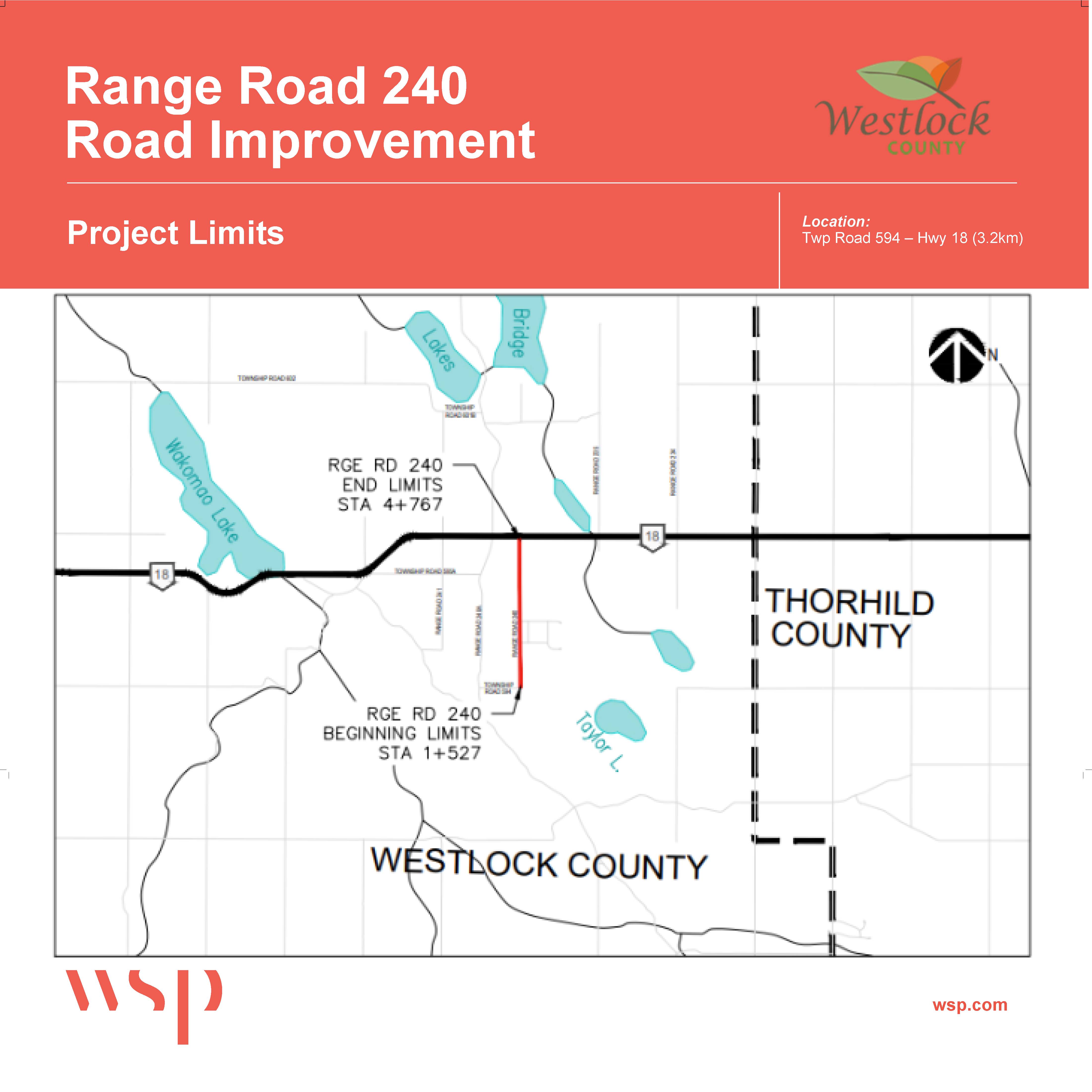
Westlock County is planning improvements to Range Road 240 (RR240) to support existing and future traffic in the area and improve overall road safety and functionality.
The project generally includes:
The design is based on standard engineering guidelines used across Alberta for rural roads, focusing on safety, durability, and efficient traffic movement.
Open House Display Boards
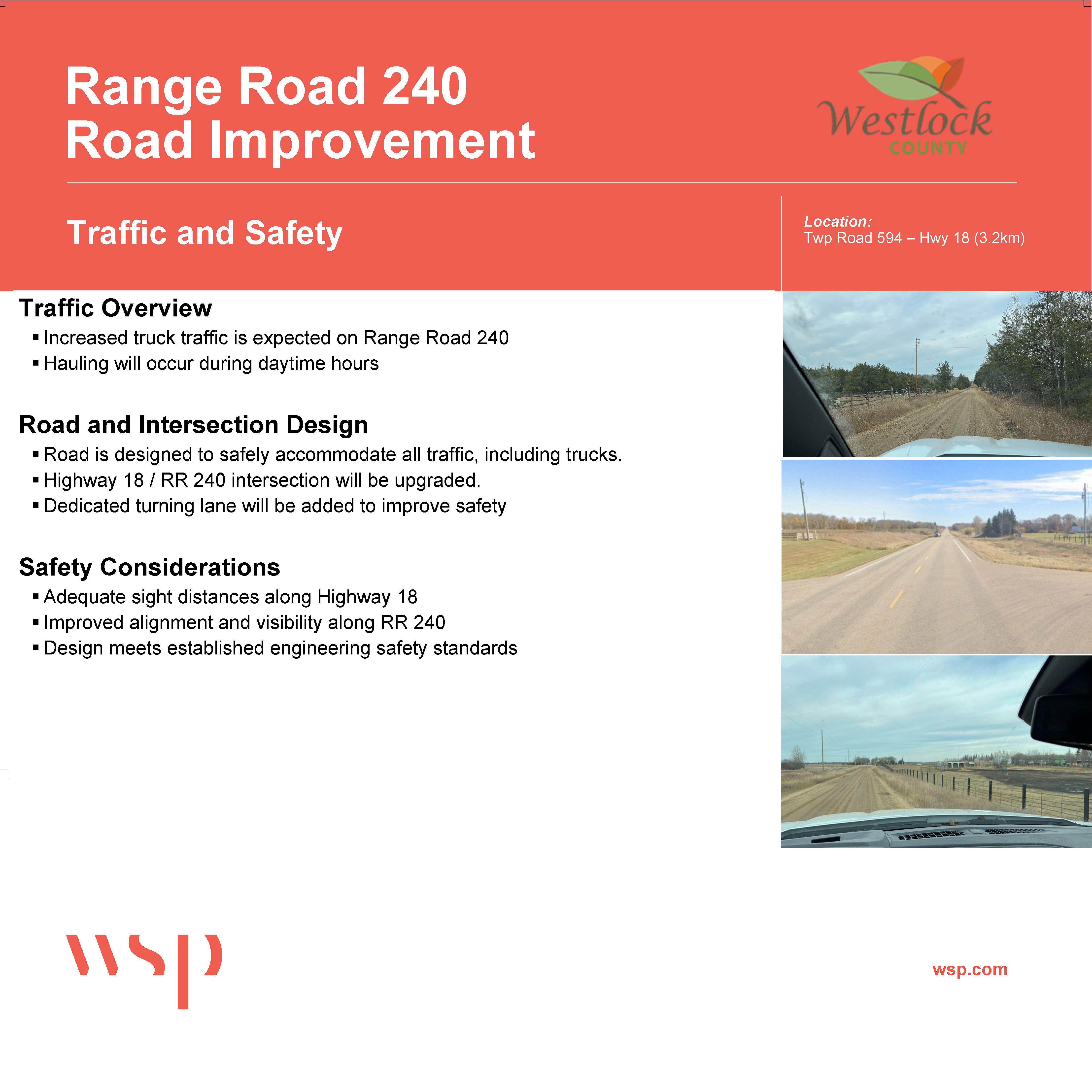
These materials were presented at the March 31, 2026 public open house.
To view the drawings, you can either click on the image, or the link below.
June 23, 2026 Regular Council Meeting
Council considered the truck route options reviewed for access to Highway 18.
Administration reviewed five potential route options. The review considered road geometry, grades, existing development, potential road upgrade requirements, land and right-of-way considerations, environmental constraints, Highway 18 connections, residential impacts, and overall suitability for regular truck traffic.
Council selected Option 4 – Range Road 240 Extension / Range Road 240 / Highway 18 as the preferred route for truck access to Highway 18, as recommended by Administration.
This decision confirms the selected route for further planning. Administration will continue reviewing the next steps for the selected route, including road design requirements, funding opportunities, potential mitigation measures, and operational considerations. Administration also recognizes that some truck traffic may continue to use existing southern routes, and those routes will continue to be reviewed as part of broader road network planning.
Supporting materials, including the Council Request for Decision document and presentation materials, are available below:
 Request for Decision - Truck Route.pdf
Presentation
Speaker Notes.pdf
March 31, 2026 – Public Open House
Westlock County hosted a public open house at the Half Moon Lake Community Hall to share information about the project and gather feedback from residents.
What We Heard
Residents shared a range of questions and comments. The main themes included:
What will the road look like once it is rebuilt?
The road is planned as a paved rural road with two travel lanes, shoulders, drainage ditches, and a rebuilt road base underneath.
Will the road be paved?
Yes, the current design includes digging out up to about 0.6 meters of material
below the road and replacing it in layers with proper compaction. That is being
done so the road has a solid foundation underneath it, not just a better
surface on top. Some imported clay fill may also be needed in lower areas to
bring the road up to the required height.
What type of asphalt will be used?
The road is planned to be paved with hot-mix asphalt.
Will the ground under the road need to be dug out and
rebuilt?
The current design
includes digging out up to about 0.6 meters of material below the road and
replacing it in layers with proper compaction. Some imported clay fill may also
be needed in lower areas to bring the road up to the required height.
Will the road be widened?
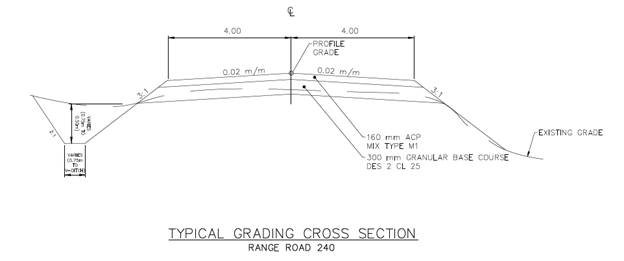
Yes. The typical section includes approximately 8 meters of paved width (two
lanes).
For more details, refer to the typical road cross-section below
Were future traffic considered?
Yes, future traffic volumes have been accounted for in the design, not just
current traffic conditions. The road and the intersection have been designed
accordingly so they can better accommodate expected traffic over time. The
traffic review in the engineering work looked at future conditions over a
long-term planning horizon, and that information has been used in the design.
What is planned for the Highway 18 and RR240
intersection?
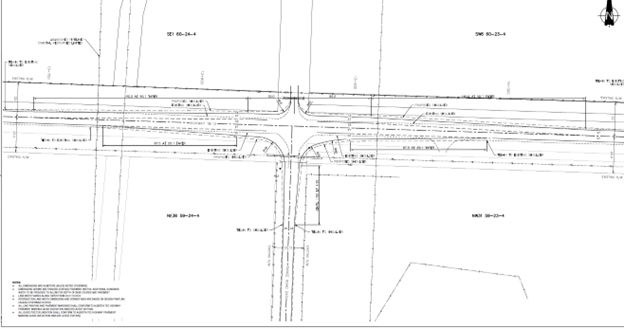
The current design includes improvements to the Highway 18 and RR240
intersection so turning movements can be handled more safely and more
efficiently. Based on the engineering review, the proposed layout is a Type
IIIb intersection treatment. In practical terms, that means added turning space
and a more formal intersection layout than what exists today.
For more details, refer to the intersection layout drawing below
Will visibility over hills improve?
Visibility and road safety have been accounted for in the design. The road
profile has been designed using standard engineering guidelines, and where
possible the design works to improve how the road carries over hills and low
spots. That said, a road like this still has to work with the existing terrain,
so not every high or low point can simply be flattened out. The main point is
that sightlines and vertical alignment have been reviewed and designed
accordingly.
Will local traffic be allowed during construction?
There may be temporary delays, restrictions, or traffic control at times, but
the intent would be to manage access rather than simply shut the road off
without a plan. More detailed information on how traffic would be handled would
come closer to construction.
Will land acquisition be required?
No. The current design has been laid out within the existing road right-of-way,
so no additional land is required for the road improvements.
How will noise and dust be reduced?
One of the ways noise and dust are being reduced is by paving the road with
asphalt instead of leaving it as a gravel surface. Paving helps control dust
and provides a smoother driving surface. Concerns were also raised about engine
braking, and those have been noted. Appropriate signage would be installed as
part of the project.
Were other routes considered?
Yes. Other route options were looked at as part of the broader planning and
discussion around access in the area. One of the questions that came up at the
open house was why RR240 is being advanced instead of another route, so we are
working to provide more information on that in future updates.
Why is RR240 being moved forward?
RR240 uses an existing road corridor and provides the most direct, shortest,
and safest connection to Highway 18 when compared to the other options that
were considered. That makes it a practical route from both a planning and
engineering perspective.
Why were other routes not preferred?
Other routes were looked at, but they came with more challenges. In general,
they were less direct, would have required more work to build or upgrade, and
could have had greater impacts on surrounding land. They were also considered
less suitable from a safety and operations standpoint compared to RR240. When
everything was considered together, RR240 was identified as the more practical
option to move forward.
What about clearing and timber salvage?
Some clearing will be required along the corridor to accommodate the road
improvements and meet safety requirements. That includes making room for the
road, ditches, and maintaining proper clear zones. Timber salvage, where
practical, would be considered as part of the construction process.
What kind of traffic is expected to use the road?
Based on the current assumptions, about 112 trucks per day are expected to be haul-related vehicles. The main design vehicle is a tandem dump truck with a pup trailer, and that has been taken into account in the road width, structure, and intersection design.
Feedback from the open house is being reviewed and will help inform the next steps in the project. Updates will continue to be shared on this page.
For questions or comments, please contact:
Development Engineering Officer
780-307-0580
